How Much Should a Local Retailer Budget for Facebook Ads? The Honest Answer
The minimum budget a local retailer needs to actually see results from Facebook and Instagram ads is $500 per month in ad spend. That is the floor. Below that, you will struggle to generate enough data for the algorithm to work properly, and you will have a hard time seeing results that are actually meaningful for your business.
But here is the real question — not what the minimum is. The real question is: are you spending enough to actually move the needle in your business? That answer is different for every retailer.
Why Most Retailers Underfund Their Facebook Ads
I see this constantly, and it comes from a few different places.
First, most retailers cannot track their ad performance accurately. When their revenue goes up for a month, they do not know if it was the Facebook ad, the direct mail piece, the Google ad, or just general foot traffic. So they are hesitant to invest heavily in something they cannot measure. That hesitation makes sense — but the answer is not to spend less, it is to set up tracking properly.
Second, because they cannot track, most retailers have no idea what their actual customer acquisition cost is. They do not know if they are paying $10 or $20 or $30 to get a customer through the door. Those numbers have drastically different implications for what a healthy return on ad spend looks like.
And third — this is the big one — most retailers say Facebook ads do not work for them because they tried it once, spent $50, nobody came in and said "I saw your ad," and they moved on.
I always use the example Gary Vaynerchuk gives about a basketball. The ROI of a basketball in LeBron James's hands is a billion dollars. The ROI of a basketball in my hands is zero — because I have never made a single dollar dribbling a basketball. These platforms have generated trillions of dollars in enterprise value for businesses around the world. They can absolutely help your local retail store. The question is whether you are using them correctly.
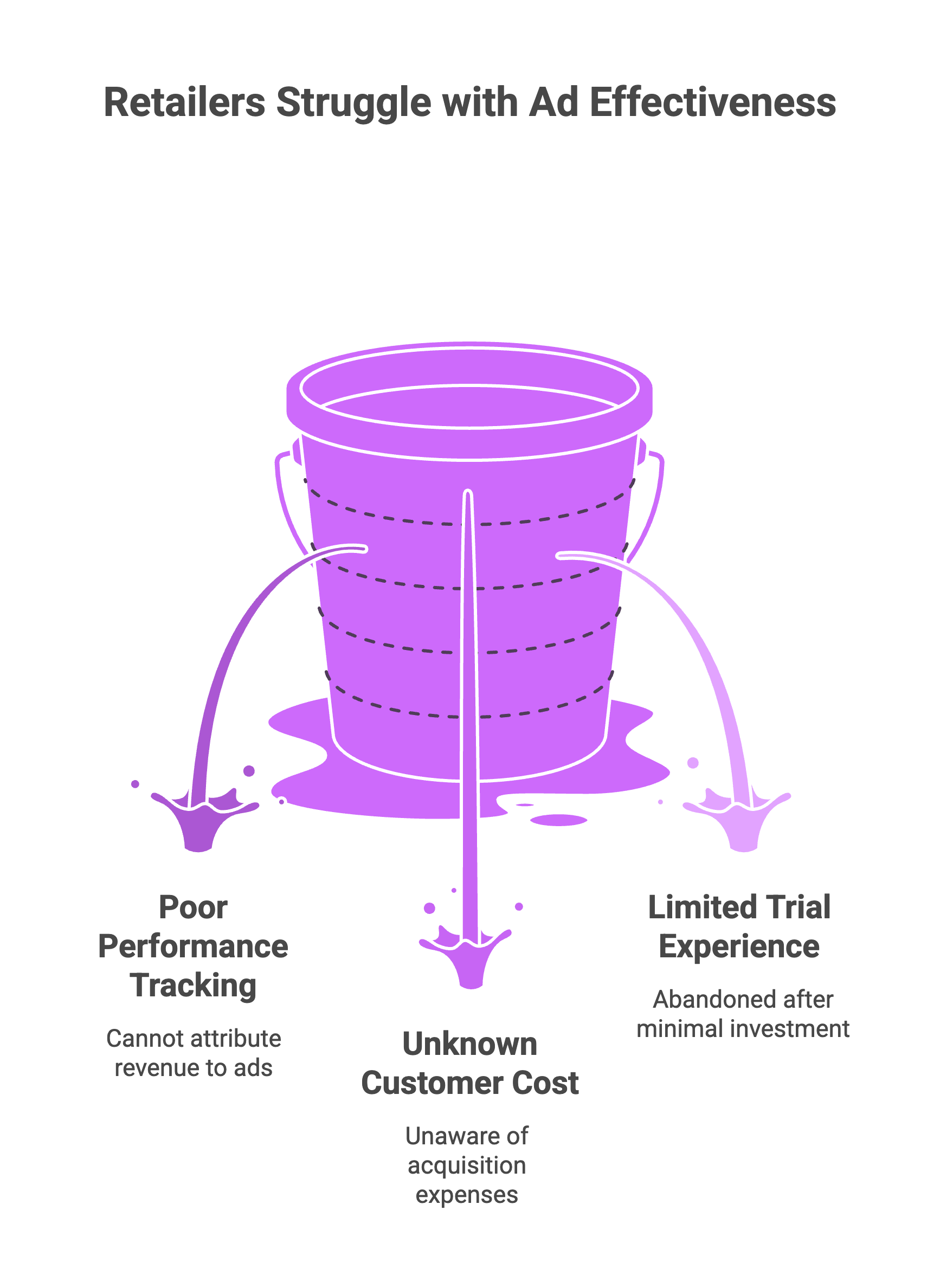
Most retailers lose their ad budget through three holes in the bucket — they cannot track results, they do not know their customer acquisition cost, and they quit before the strategy has a chance to work.
Stop Thinking in Dollars. Start Thinking in Percentages.
The most common mistake local retailers make with their ad budget is thinking about it in raw dollar amounts instead of as a percentage of revenue. Here is the framework I use with every client:
4-8% of your total annual revenue should go toward marketing
2-4% of your total revenue should go specifically to Facebook and Instagram
That means roughly half of your total marketing budget should be going to Meta. Here is what that actually looks like in practice:
• $500,000/year retailer — $1,000 to $2,000/month on Meta minimum
• $1,000,000/year retailer — $2,000 to $4,000/month on Meta minimum
• $2,500,000/year retailer — $5,000 to $10,000/month on Meta minimum
• $5,000,000/year retailer — $10,000 to $20,000/month on Meta minimum
Here is why this matters. I have seen retailers spending $1,000 per month on Facebook ads for a business doing $5 million in annual revenue. Even if those ads perform at a 10X return on ad spend, that is only $10,000 in attributed revenue for the month. On a business doing $400,000-plus in monthly sales, that is barely 2.5% growth. You will never feel it.
The marketing is not failing. The investment is just too small to create a visible result. And if your agency is letting you spend $500 per month on a million-dollar business without having that conversation with you, that is a problem.
The goal is not just a good return on ad spend. The goal is to grow your top-line revenue. A 10X ROAS on $300 per month is still only $3,000. If you are a $100,000 per month retailer, that is 3% growth at best. You need to spend enough that the results are actually felt.
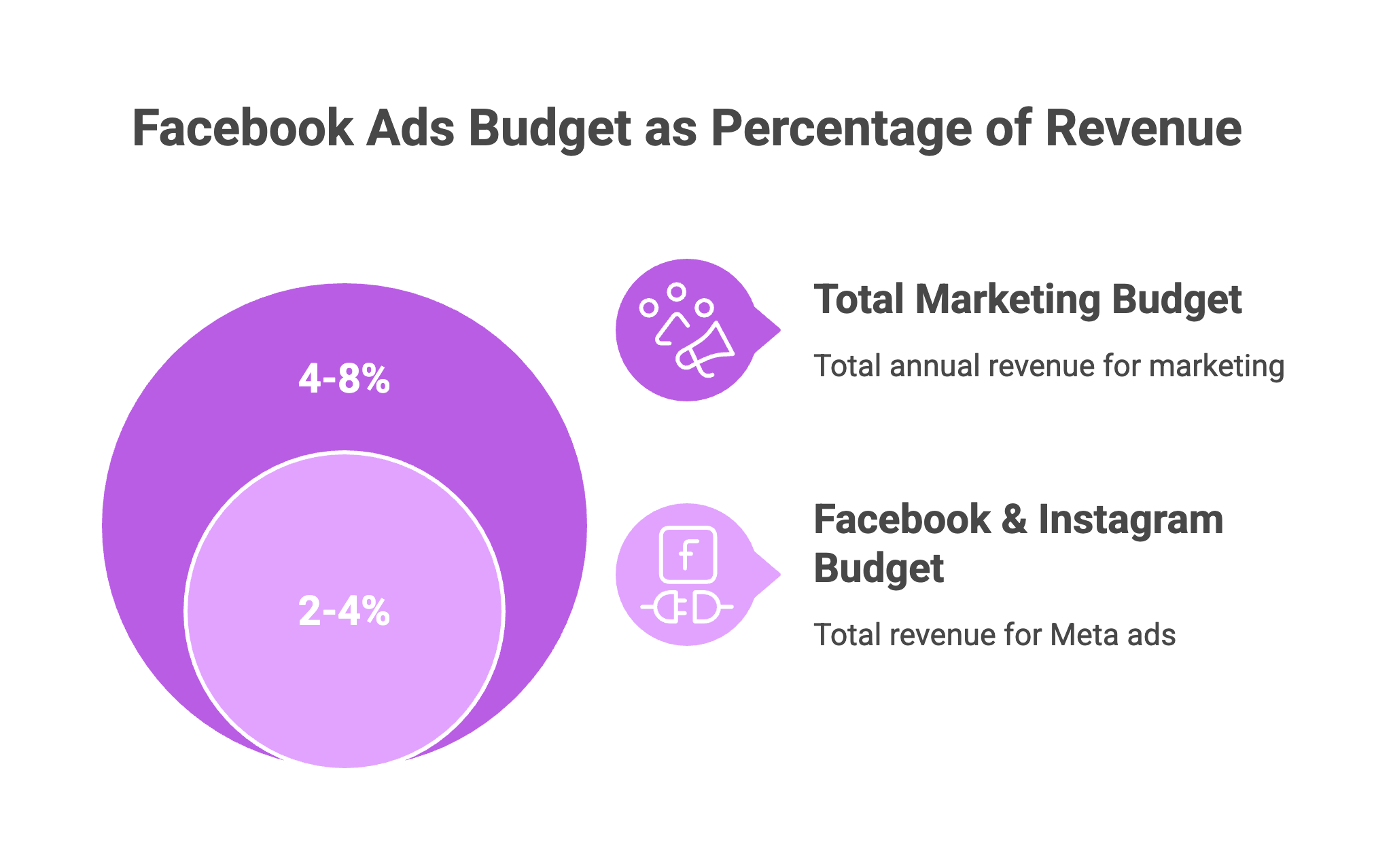
The percentage of revenue framework: your total marketing budget should be 4-8% of annual revenue, with 2-4% going specifically to Facebook and Instagram. Half your marketing budget belongs on Meta.
The $500/Month Starting Point: How to Make It Work
If you are just getting started and $500 per month is where you are, that is okay — but you have to be smart about how you deploy it.
The most important question to ask yourself at a lower budget is: how many people are within a tight radius of my store, and can I dominate that audience with this amount of money?
Think about it this way. If you tighten your radius to one mile around your store and there are 5,000 people living within that radius, you can put your ads in front of nearly every single one of them on a $500 budget. You become the most known retailer to everyone within a mile of your location. That is a powerful position, even at a modest spend level.
The tighter your radius, the more cost-efficient your spend becomes because you are not wasting budget trying to reach people who would never drive to your store anyway. Start tight. Prove the return. Then expand.
What This Actually Looks Like: A Real Client Result
Let me give you a real example rather than just talking about numbers in the abstract.
We have a retail client in California that had over 26,000 customers sitting in their point of sale system. These were people who had shopped with them before — real customers, real purchase history, real data. And they were not doing a single thing to follow up with those customers on Facebook and Instagram. That data was just sitting there, dormant, generating zero marketing value.
We plugged in our software, Omni Lightning, to extract those customers from their POS system, match them to actual Facebook and Instagram profiles using their first-party data, and began serving them targeted ads designed to drive them back into the store.
Here are the results from April 2026:
$627 total ad spend for the month
6,837 existing customers reached with ads
34,184 total impressions
$1,421 new customer revenue directly attributed
$13,805 existing customer revenue directly attributed
$15,227 total revenue generated
24.3X return on ad spend
That is $627 in spend generating $15,227 in documented, tracked, in-store revenue. Not estimated. Not modeled. Tracked through offline conversions and POS data matching.
The most important number in that case study is not the 24.3X ROAS. It is the $13,805 in existing customer revenue. More than 90% of the return came from re-engaging people who had already shopped there. Your best new customers are often your old ones.
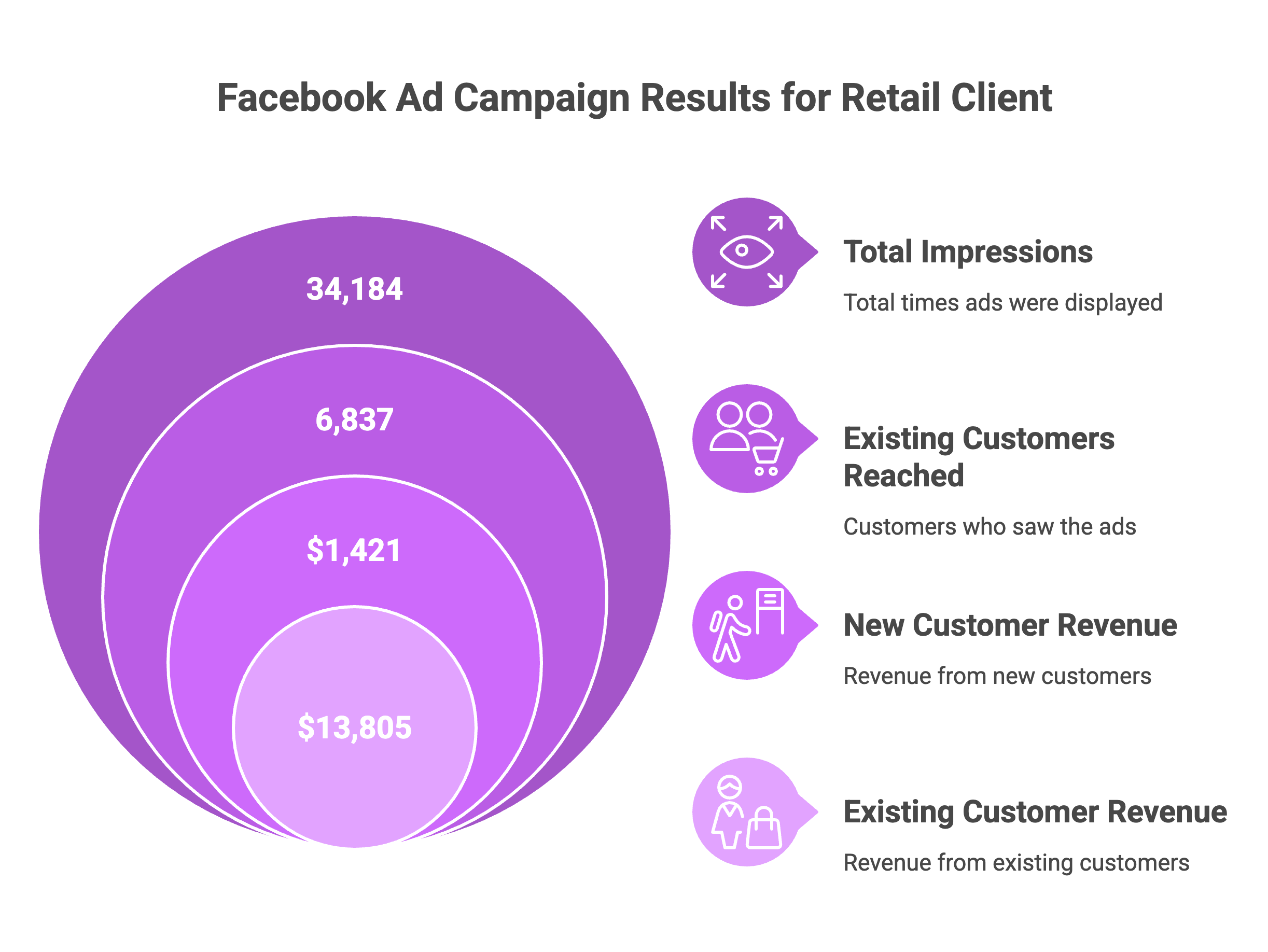
This is a real client result from April 2026. A California retailer with 26,000+ customers in their POS system spent $627 on Meta ads and generated $15,227 in tracked in-store revenue — a 24.3X return. The four numbers shown represent total impressions, existing customers reached, new customer revenue, and existing customer revenue. More than 90% of the return came from re-engaging people who had already shopped there.
ROAS vs. ROI: Why Both Numbers Matter
This is a distinction most retailers miss.
Return on ad spend (ROAS) tells you how efficiently your ads are performing. A 10X ROAS means for every dollar you spent on ads, you made $10 in revenue. That is a measure of the campaign's performance.
Return on investment (ROI) for your business asks a different question: did the amount I spent on advertising actually grow my business in a meaningful way? A high ROAS on a tiny budget can still mean zero real business impact.
You need both to be healthy. The goal is not just to run efficient campaigns — it is to run efficient campaigns at a scale that actually moves your top-line revenue number. That is the conversation most agencies are not having with their retail clients.
Ad Spend vs. Agency Fees: Understanding What You Are Actually Paying For
This is one of the most important conversations I have with every new retail client — and one most agencies never have at all.
Your ad spend and your agency fee are two completely separate things. Your ad spend is the money that goes directly to Facebook and Instagram to show your ads. Your agency fee is what you pay the agency to build, manage, and optimize those campaigns.
The ratio that matters is this: your ad spend needs to be at least equal to your agency fee — ideally two to three times your fee. If your agency charges $2,000 per month to manage your campaigns, your ad spend should be at minimum $2,000 per month as well. Preferably $4,000 to $6,000 or more.
If you are paying $2,000 in agency fees and only spending $500 on ads, the math falls apart. Even with a strong ROAS, you are not generating enough total revenue to cover your cost of goods, your margins, and your total marketing investment.
At Omni Digital Group, our management fee stays flat. The more you invest in ads, the lower percentage of your total budget our fee represents. A retailer spending $500 a month in ads with a $2,000 management fee is paying 80% of their budget on management and 20% on reaching customers. A retailer spending $5,000 a month in ads with the same $2,000 fee is paying 29% on management and 71% on reaching customers. The math gets dramatically better as your ad spend increases.
When to Increase Your Budget
Once campaigns are running, here are the signals that tell you it is time to spend more:
• Your ROAS has been consistently above your target for 7 or more consecutive days
• Your cost per result is stable or improving week over week
• Your frequency is below 4 — meaning the same person has not seen your ad more than 4 times
• Your in-store traffic is trending upward in a way that aligns with your campaign activity
When those four signals are pointing in the right direction, increase your budget by 20 to 30 percent at a time. Never double or triple overnight — that restarts the learning phase and can tank a campaign that was working.

Before increasing your Facebook ad budget, these are the four signals your campaigns need to show first. Consistent ROAS, stable cost per result, and low frequency tell you the campaign is working efficiently. Increased in-store traffic confirms it is translating to real business. When all four are pointing in the right direction, a 20 to 30 percent budget increase is the right next move — never double overnight.
The Honest Bottom Line
• Start at $500/month minimum. Below that you cannot generate enough signal to measure results reliably.
• Think in percentages, not dollars. You need 2 to 4% of your annual revenue going to Meta ads specifically, within a 4 to 8% total marketing budget.
• Make sure you can actually track it. Without offline conversion tracking and POS data matching, you are guessing. And guessing leads to underfunding.
• Use the data you already have. Your POS system is full of customers who have already shopped with you. That is your best audience and your fastest path to measurable results.
• Spend enough that it can actually move your business. A 10X return on $200 is still only $2,000. On a $1M business, that is noise.
Your target demographic is spending the majority of their social media time on Facebook and Instagram. That is not an opinion. That is where the data points. And that is where your marketing budget should go.
Frequently Asked Questions
Can I start with $300 per month?
Technically yes, but you will struggle to see results that are meaningful for your business. You are below the threshold where the algorithm has enough data to optimize. If $300 is your starting point, go as tight as possible on your radius — 1 to 2 miles around your store — and be patient. But understand that even a great ROAS at that spend level will not move your revenue visibly.
Is there a maximum budget I should not exceed?
No hard ceiling. If your ROAS is healthy and you have available budget, there is no reason not to scale. The only cap is when your return on ad spend drops below your profitability threshold.
I am already spending $1,000 per month and not seeing results. Should I spend more?
Not yet. The problem is almost certainly not the budget — it is strategy, creative, audience, or tracking. Throwing more money at a broken campaign just burns money faster. Diagnose first. Are you using your POS data? Is your creative driving to a specific action? Do you have offline conversion tracking set up? Fix those things first, then scale.
How do I know if I am underfunding?
Compare your monthly ad spend to your monthly revenue. If you are under 2% of monthly revenue, you are most likely underfunding. If the results feel invisible against your normal business fluctuations, you probably are.
Should I run ads year-round or ramp up seasonally?
For retail, your budget should breathe with your business. Slower months run at your baseline percentage. Your peak seasons — Q4, Mother's Day, key events for your vertical — should ramp up 4 to 6 weeks in advance. But maintain some level of spend year-round so your campaigns stay out of the learning phase when you need them most.
Want to see what the right budget looks like for your specific store?
We will show you exactly how we would build the strategy, what audience size you are working with, and what a realistic return looks like — before you spend a dollar.