The Ultimate Retail Marketing Guide for 2026
How Retailers Should Plan Marketing, Acquire New Customers, Retain Existing Ones, and Use POS Data to Grow in 2026.
If you’re a retailer heading into 2026 without a clear marketing plan, you’re not alone. Most brick-and-mortar businesses don’t struggle because they lack good products, good people, or even good locations. They struggle because they don’t fully use their data — and they don’t have a clear system for turning marketing into measurable growth.
After working with hundreds of retailers and helping generate hundreds of millions of dollars in local, in-store sales, one thing is clear:
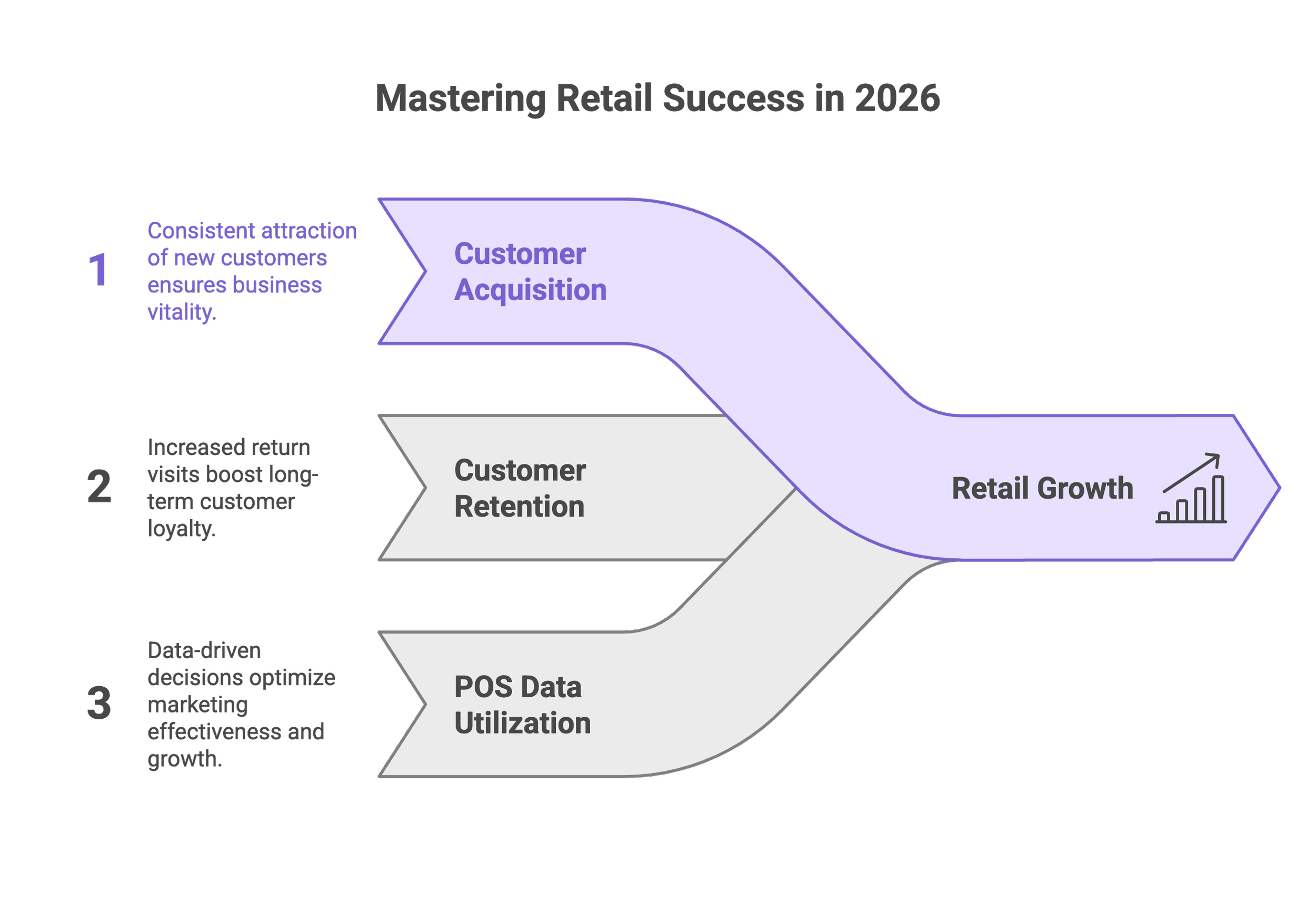
Retailers who win in 2026 will be the ones who master three things:
Getting new customers consistently
Getting existing customers to come back more often
Using POS data to guide every marketing decision
This guide breaks down exactly how to do that.
Why 2026 Will Be a Turning Point for Retail Marketing
Retail has always been competitive, but the gap between well-run retailers and everyone else is getting wider.
The reason is simple: Data-driven retailers compound growth. Everyone else guesses.
Your competitors have access to the same brands, similar pricing, and often similar locations. The real advantage comes from:
Knowing who your customers are
Knowing what they buy
Knowing when they are likely to buy again
And knowing how to reach them efficiently
That all starts with your point-of-sale system.
The Most Underutilized Asset in Retail: Your POS Data
Most retailers think their biggest assets are:
Their people
Their inventory
Their building
Those are important. But there’s a fourth asset that belongs in the top five and is almost always underused:
Your data.
Every transaction that runs through your POS system tells a story:
Who bought from you
What they bought
How much they spent
How often they return
Where they live
Yet many retailers either:
Don’t collect enough data at checkout
Don’t know how to use it
Or don’t have the systems to activate it
In 2026, that’s no longer optional.

Step One: Build Your 2026 Marketing Plan Around Data (Not Guessing)
Before talking about ads, platforms, or campaigns, retailers need to answer one simple question:
What percentage of your revenue comes from new customers vs. returning customers?
Most retailers are shocked when they actually run this analysis.
Across large retail datasets, roughly 59% of customers shop one time and never return. That means more than half of your customer base is walking out the door — even though they already trusted you enough to buy once.
Your 2026 plan should start with:
Reducing one-time buyers
Increasing repeat visits
Increasing lifetime value
That’s where marketing becomes predictable.
Getting New Customers in 2026: What Still Works (and What Doesn’t)
New customer acquisition is still critical. But how you do it matters more than ever.
Focus on the Platforms That Actually Drive Local Sales
For most retailers, Meta platforms (Facebook and Instagram) remain the strongest channels for local growth. Why?
Because:
The 40+ demographic controls the majority of spending power
These platforms allow precise geographic targeting
They integrate well with customer data
The goal isn’t to advertise to everyone in your city. The goal is to advertise to the right 50,000 people around your store.

The Three Types of Content Retailers Must Run in 2026
Retailers that grow consistently don’t rely on one type of ad. They run a balanced content mix.
1. Branding Content (Always On)
This content answers one question:
“Why should I trust this store?”
Branding content should highlight:
How long you’ve been in business
Where you’re located
Who you serve
What makes you different locally
This content runs year-round and builds familiarity so that when people are ready to buy, your store feels like the obvious choice.
2. Product Content (What You Sell and Why It Matters)
Product content should:
Showcase your top brands or categories
Compare similar products people already research
Highlight the problems you solve
Examples:
Appliance stores: broken appliances, remodels, upgrades
Shoe retailers: comfort, performance, lifestyle use
Jewelers: engagement, gifting moments, milestones
In 2026, product education wins. People don’t want pressure — they want clarity.
3. Sales and Event Content (Short Bursts That Drive Action)
Retailers who never run promotions fall behind.
Sales content works best when it’s:
Time-bound (weekend sales, events)
Dollar-based instead of percentage-based
Used strategically to move inventory
Events paired with ads are especially powerful. Retailers consistently generate tens of thousands in incremental revenue by promoting in-store events through paid ads and customer lists.

Retaining Existing Customers: The Biggest Growth Opportunity for 2026
If you want faster growth with lower ad costs, this is it. Why Retention Beats Acquisition
Your existing customers:
Already know your brand
Already trust you
Cost less to market to
Convert at higher rates
Yet most retailers only use email to reach them — if that.
In 2026, retention should include:
Paid ads to past customers
SMS campaigns
Segmented messaging based on past purchases
The Data You Must Capture at Checkout (No Exceptions)
If you want better marketing results, your data has to improve first.
At minimum (highlighted), retailers should capture:
First and last name
Phone number
Email
City, state, zip
If you only collect one thing, collect the phone number.
Phone numbers are the most reliable identifier across ad platforms — Meta, TikTok, Snapchat, and future platforms that don’t even exist yet.
This future-proofs your marketing.
How to Use POS Data to Drive Smarter Marketing
Once data is collected, it should be used — not stored.
The Most Valuable POS Data Segments for Retailers
Retailers can segment customers by:
Entire customer database
Brand purchased
Product category
Purchase frequency
Time since last visit (inactive customers)
Total spend (VIP customers)
Store location
Month or season of purchase
Segmentation allows you to:
Personalize messaging
Time ads correctly
Increase relevance
Improve ROI
This is how large brands win — and local retailers can do it too.

The Power of Personalization in 2026
Personalized marketing isn’t a buzzword. It’s a performance driver.
When customers see ads that:
Reflect what they already bought
Match their interests
Appear at the right time
They respond. This is how retailers turn:
One-time buyers into repeat buyers
Seasonal shoppers into loyal customers
Marketing into a predictable growth engine
Making Marketing Measurable (So You Know What’s Working)
The biggest frustration retailers have is not knowing which ads drive real sales.
In 2026, marketing must be measurable.
That can include:
POS-to-ad integrations
Tracking codes
Event redemptions
Customer matching
The goal is simple:
Know which marketing dollars create in-store revenue.
When you know that, scaling becomes easy.
What Retailers Should Do Right Now for 2026
If you take nothing else from this guide, do these four things:
Audit your POS data: Make sure you’re collecting names, phone numbers, and emails.
Segment your customers: Especially inactive customers and top spenders.
Run ads consistently: Not just during holidays or sales.
Make everything measurable: Even basic tracking is better than none.
Retail growth doesn’t come from luck. It comes from systems.
Final Thoughts: The Retailers Who Win in 2026
Retailers who grow in 2026 will:
Use data as a growth asset
Focus on retention as much as acquisition
Personalize marketing instead of blasting messages
Measure what matters
The opportunity is massive — especially for local retailers willing to modernize how they market.
Your data already holds the answers. 2026 is the year to use it.